Bulk Dog Chew Toys: What 120 Pieces Actually Buys

The piece I would open with, if the fixture is a bone and not another molded stick, is Fiber Bone Chew (SKU MN-1211). Materials on file are PA and cowhide fiber. Sizes are S 13.5×5×3.5 cm, M 16×6.2×4.2 cm, and L 20.5×7.5×5.8 cm. Weights on file are about 95 g, 170 g, and 310 g. Color is beige. Pet type is dogs. Catalog MOQ is 120. There is no Shore number, no chew-hour claim, and no certification field on this record. If a retailer asks whether the large is "the power chewer," the honest answer is the sample, not a bullet copied from someone else's listing.
Two neighbors keep the first screen honest. Key Chew Flat (MN-1245) is molded TPR, 16×4.3×1.8 cm, 35 g, color Mix, same catalog MOQ 120. Key Chew Mini (MN-1244) is also TPR, 9.1×2.5×1.4 cm, 16 g, Mix, MOQ 120. Same series. A bone that can weigh 310 g in large, a flat paddle at 35 g, and a pocket stick at 16 g. If the PO says "chews, assorted, 120 total," receiving will guess, and they will guess wrong.
The parent bay is the Classic Chew collection. Bones already have a wholesale write-up for the coated PA/PU bone. Rope sticks have theirs. This page is the bulk decision: which chew you put 120 of in the first carton, and which gaps you leave as "confirm on quote."
Open the bone line on fiber, not on a mixed bag
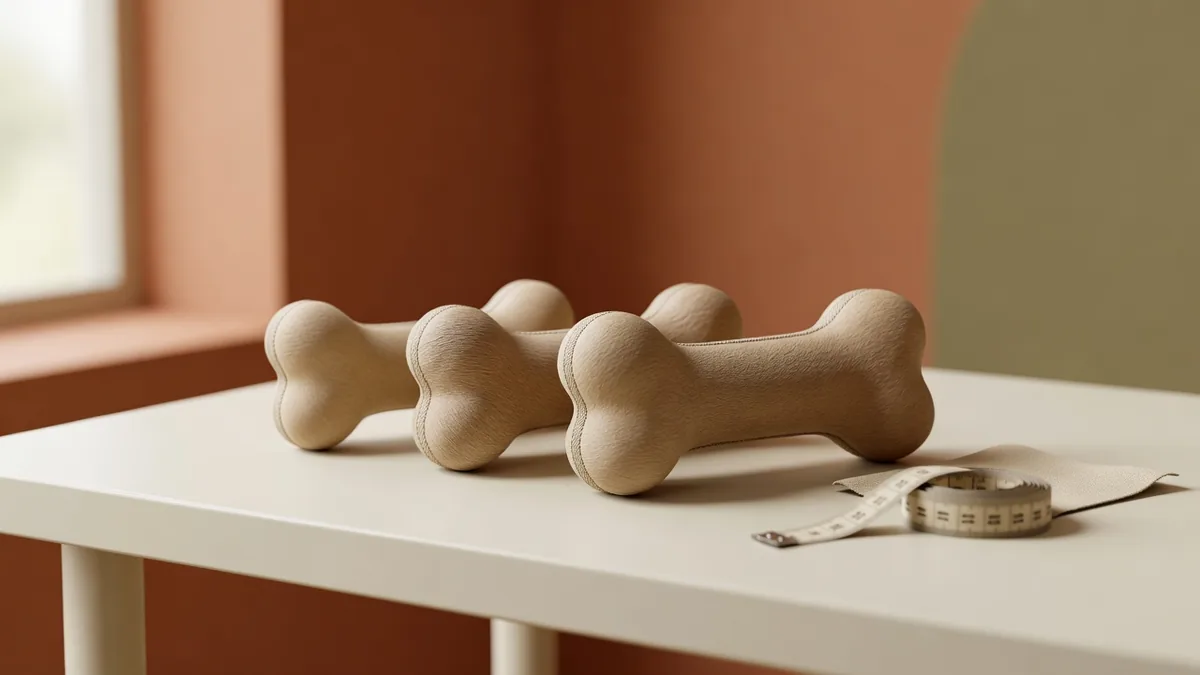
Fiber Bone Chew is one SKU with three sizes on the record, not three SKUs. That matters when someone writes "one of each size inside the MOQ." The database lists a single MOQ of 120 and a size run. It does not say the 120 may be split 40/40/40. Ask on the quote. Do not assume a size ratio because the product page shows S, M, and L.
The gram jump is the part buyers miss in a photo. Small is about 95 g. Medium is about 170 g. Large is about 310 g. Large is more than three times the small. A hangtag that says "medium chew" across the run will be wrong for at least two of them. Put the centimeter string and the gram weight on the carton mark, or the warehouse will pick L when the photo was S.
Beige is the only color on file. There is no second colorway to hide a dye-lot problem. If the brand needs a house green or a seasonal orange, that is a private label conversation, not a silent swap against this beige unit.
I would not open a bulk chew program on Large alone unless the shop actually sells to big mouths. Three hundred ten grams changes the master carton and the dog you imply on the shelf. Small at 95 g is the closer first peg for a mixed pet shop that cannot face three bones. Medium sits in between and is the one I would add on reorder once Small actually moves.
Real Bone Chew (MN-1203) is the sister bone, and it is not the same material story. File says PA and TPR, orange, S 12.5×4.8×4 cm at about 110 g and L 16.5×6.8×5.5 cm at about 260 g, catalog MOQ 120. Fiber is cowhide fiber plus PA, beige, and goes up to about 310 g. If a buyer says "same bone, different color," they are asking for a different material line. Quote them separately.Coated Bone Chew (MN-1202, featured) is a third bone: PA and PU, green, S/M/L from about 65 g to 200 g, MOQ 120. Useful context. A bad substitute when the brief said cowhide fiber. The coated piece already has its own buyer page. Do not restock it from this one.
Key Chew is the light bulk, and the MOQ does not blend
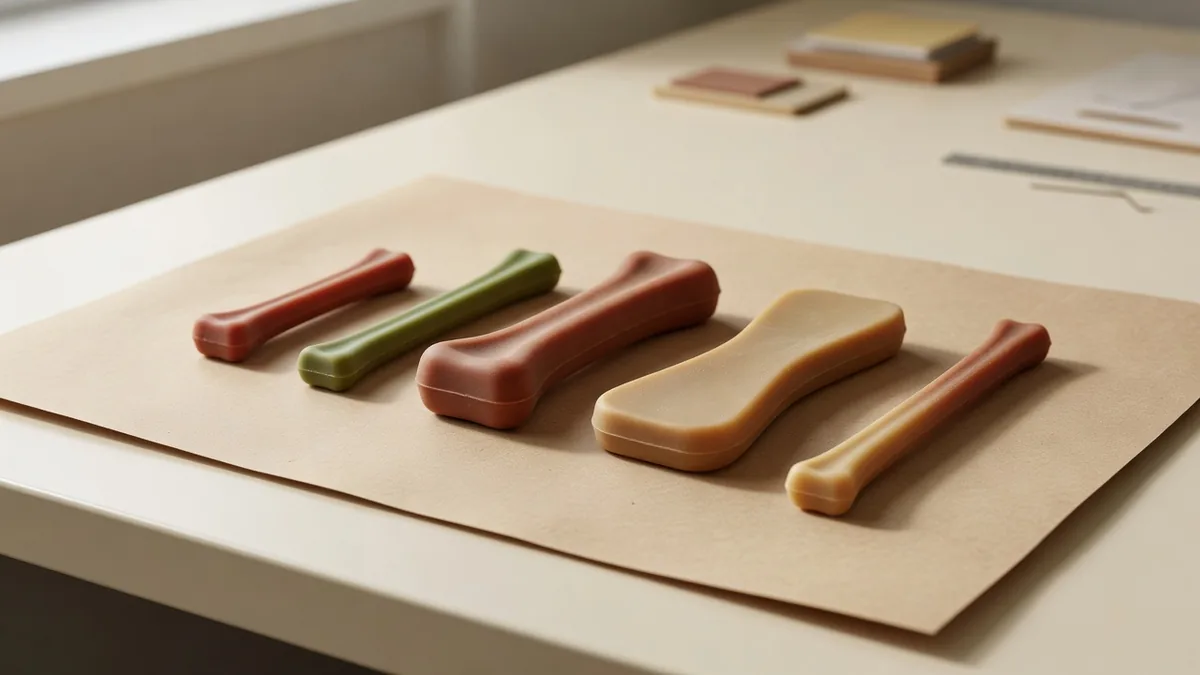
If the shop cannot give a bone 20 cm of shelf, the Key Chew family is the lighter bulk. Every row below is TPR, dogs, color Mix, catalog MOQ 120. No hardness rating sits on these records.
| SKU | Size on file | Weight | Color | MOQ |
| --- | --- | --- | --- | --- |
| Key Chew Mini, MN-1244 | 9.1×2.5×1.4 cm | 16 g | Mix | 120 |
| Key Chew Slim, MN-1241 | 12×3.9×2.1 cm | 42 g | Mix | 120 |
| Key Chew Wide, MN-1242 | 12×3.5×4 cm | 63 g | Mix | 120 |
| Key Chew Flat, MN-1245 | 16×4.3×1.8 cm | 35 g | Mix | 120 |
| Key Chew Long, MN-1243 | 21×2.5×2.5 cm | 33 g | Mix | 120 |
Mini is the checkout piece. Sixteen grams, under 10 cm. I would not hang it beside Fiber Bone Large and call them one program.
Slim and Wide share a 12 cm length and then split. Slim is 42 g and narrow. Wide is 63 g and the heaviest Key Chew in this set. "Same as slim, just thicker" is a different gram weight. It gets its own line on the PO.
Flat is the paddle: 16 cm long, only 1.8 cm thick, 35 g. Long looks like the big one at 21 cm and weighs 33 g, almost the same as Flat. Length on a photo is a bad proxy for carton weight.
Five shapes means five minimums unless the quote says a mixed pack is allowed. I have seen first orders written as "Key Chew assorted, 120 pcs." That note does not match the catalog. Each of Mini, Slim, Wide, Flat, and Long carries MOQ 120. Five openers is 600 pieces before you add a bone. For a first bulk chew order, pick one. Flat if the peg is wide and shallow. Long if you want the silhouette to read from the aisle. Mini only if the fixture is a bin.
Rubber Chew Stick (MN-1253) is also TPR, dogs, MOQ 120, colors yellow, blue, and pink. The catalog does not list a size or a weight. Leave those cells blank until a pre-production sample is on a scale. Do not borrow Key Chew Long's 21 cm because both names say stick.Who should buy 120 of which chew
A pet specialty shop with one chew facing should pick a single hero and stop. Fiber Bone small or medium if the story is a bone. Key Chew Long if the story is a stick you can see from the aisle. Adding the whole Key Chew family plus three bone sizes on day one is a photo problem and a cash problem. You will shoot shapes you have not sold.
Marketplace brands have a worse version of the same trap. Fiber Bone S at 13.5 cm and L at 20.5 cm are not a colorway. They are different enough that one image set misleads. So are Mini at 9.1 cm and Long at 21 cm. If you list them, list the centimeter string in the title, not "assorted bulk chews."
Distributors who already carry plush and keep hearing that the toys are too soft usually want something firmer next to the plush wall. A TPR stick or a fiber bone changes the shelf story. It does not prove bite resistance. There is no lab result on these SKUs. Write "PA and cowhide fiber, large about 310 g" or "molded TPR, 33 g" and stop there.
Skip Fiber Bone Large as the hero if the brand promise is a puppy kit. Mini at 16 g is the closer fit, and even that is a general dog chew on file, not a teething claim. A 310 g bone in a puppy photo is how the wrong customer buys it.
Power-chewer copy is a different conversation, and the catalog cannot finish it. If the buyer needs a destruction claim or a Shore number, put the test on the RFQ. Do not invent one to make the bulk page sound tougher.
Rope and foam are neighbors, not free fillers
A mixed "bulk chews" carton is where rope sneaks in. Puppy rope in this series is TPR plus cotton, not a cotton-only braid, and not a quieter Key Chew.
Puppy Rope Bar (MN-1250) is TPR and cotton, 21×2.5×2.5 cm, 33 g, Mix, MOQ 120. That envelope matches Key Chew Long almost exactly: same centimeters, same grams. The difference on file is the cotton. If the line sheet does not say "TPR" versus "TPR + cotton," the warehouse will treat them as duplicates and short one. Puppy Rope Flat (MN-1251) is the same trick against Key Chew Flat: TPR and cotton, 16×4.3×1.8 cm, 35 g, Mix, MOQ 120. Flat paddle, cotton in the material list. Puppy Rope Stick (MN-1249) is the heavier one, TPR and cotton, 22×4.1×4.1 cm, 62 g, pink and yellow, MOQ 120.Then nylon, which is not the puppy set. Nylon Rope Stick (MN-1205) is PA and nylon, blue, about 17×4.5 cm, 200 g, MOQ 120. Two hundred grams against Key Chew Long at 33 g is not "a slightly bigger reorder." It changes the carton and the dog on the hangtag. Do not call it cotton because an older blurb said rope.
Woven Foam Ball (MN-1218, featured) is another bay: TPR and foam, blue, about 7 cm and 7.5 cm, weights on file about 102 g and 119 g, MOQ 120. Fine as a Classic Chew neighbor. A bad silent substitute when the buyer asked for bulk chew sticks. A ball does not fill a stick facing.None of these rope or foam rows can be used to "top up" a 120 on Fiber Bone. MOQ sits on the SKU. Blending is a quote question.
What to lock before the bulk PO
Specs worth writing down, and only these, because they are on the product record:
- Hero SKU code, not the family name. MN-1211 is not "the bone." MN-1245 is not "the flat one."
- Size string and gram weight for the unit you are actually shipping. If you take Fiber Bone, say which of S, M, or L, and whether a ratio inside 120 was confirmed in writing.
- Material line copied from the database. PA + cowhide fiber, TPR, TPR + cotton, or PA + nylon. Do not merge them into "rubber and rope."
- Color on file: beige, Mix, orange, green, blue. A new Pantone is a new conversation.
- Catalog MOQ 120 per SKU, destination market, and whether you need a pre-production sample before the bulk leaves.
What not to lock, because it is not in the database: chew grade, hours of chew time, ASTM or EN71 pass on this colorway, or a retail price. Ask for tests on the ODM brief if the channel requires them. Do not print a certificate you have not seen.
Pack-out is the other place bulk orders go soft. Inner bag, hangtag, barcode, and master carton dimensions are not on these chew records. Put them on the PO. A 16 g Mini and a 310 g bone do not share a carton spec even if both say MOQ 120. If you sell on a marketplace, the pack-out photo has to match the unit that ships. "Assorted" is how the return ticket gets written.
Sampling is ordinary, not a special favor. For a first bulk chew order I would rather hold the 120 until one approved piece of the hero SKU is back in the buyer's hand, weighed, and checked against the size string. A second shape can wait for the reorder. Teams that approve five shapes from one studio photo usually discover the cotton rope and the plain TPR are the same length only after the cartons land.
The products catalog is the place to confirm the live Classic Chew rows before you send the brief. If a slug is inactive, do not build the order around it.
A short bulk order that does not invent a mix
Here is a first order I would actually send, for a shop that wants chew and does not want a science project.
One hero: Fiber Bone Chew, small or medium, 120 pieces, beige, size called out on the carton. Not all three sizes unless the quote allows a split.
One stick, only if there is a second peg: Key Chew Flat or Key Chew Long, another 120, Mix. Not all five.
No rope in the first PO unless someone on the buyer side can explain TPR versus TPR + cotton to the receiver. No foam ball as a filler. No "assorted chews, 120 total."
If the brand needs a logo, a new color, or a hangtag with their name, that work sits on private label pet toys, with the base SKU named. Color on file stays the default until a strike-off exists. Logo method and warning copy are part of that brief, not a note in the margin of a bulk email.
Lead time, payment terms, and a mixed-size ratio are confirm-on-quote items. I will not put a day count here that the catalog does not state.
When the hero is chosen, contact Wagnab with the SKU code, the size, the quantity per SKU, and the market the goods are going to. A bulk chew order is easier to price when it names MN-1211 or MN-1245 than when it says "a mix of durable toys."
Ready to Build Your Next Collection?
From material selection to final delivery, we help brands bring pet toys to market.