Pet Supplies Private Label With Packaging Design: Buyer Spec Guide

If you are shopping pet supplies private label with packaging design, you are rarely looking for a blank polybag and a generic hangtag. You want a sellable product that looks like your brand on Amazon, in a pet retailer bay, or in a gift multi-pack — with carton marks that clear inbound, barcodes that scan, and warnings that match the market you ship into.
This guide is for brand buyers, marketplace sellers, and wholesale distributors who treat packaging as part of the product, not a last-minute add-on. It covers what private-label pack-out actually includes, how to brief a factory on print and structure, MOQ bands that print shops and toy lines share, QC that catches wrong artwork before a container sails, and when stock packaging beats a full custom structure.
What private-label packaging actually covers in pet programs
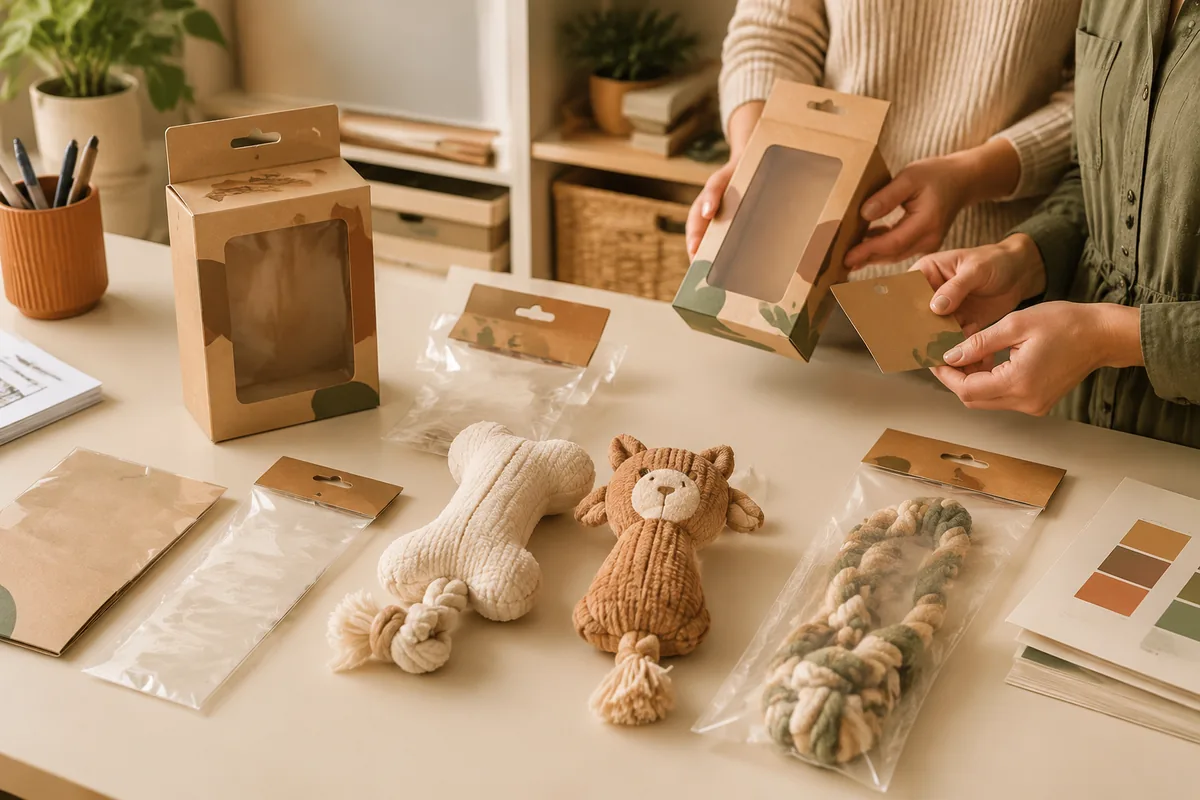
In export pet soft goods and chew toys, “private label with packaging design” usually means a stack of layers, not a single box:
- On-product branding: woven label, heat-transfer logo, embroidered logo, or printed hangtag
- Primary pack: printed polybag, kraft bag, header card, blister, or retail window box
- Secondary pack: color carton or master carton with product name, barcodes, destination marks
- Compliance copy: multi-language warnings, age or supervision notes, material callouts where required
- Logistics data: SKU codes, carton dimensions, packing quantity, country of origin
Factories that only sew plush or braid rope often partner with a print house for cartons and bags. Your PO may have two production clocks: toy production and print production. If you only schedule the sewing line, the artwork still sits in a queue while you miss a launch window.
Browse the products catalog for reference SKUs before you design packaging around a silhouette that is still in sample. Packaging designed for a tall drumstick plush will not fit a short donut body without a costly reprint.
Who buys packaging-forward private label (and what each needs)
Serious demand on this keyword usually falls into a few buckets:
- DTC brands that need consistent unboxing photos and hangtag color across reorders
- Amazon and marketplace sellers who live or die by scannable barcodes and clean listing photography
- Retail buyers who need shelf-ready packs, planogram height, and multi-language legal copy
- Distributors who want mixed-SKU master cartons without chaos at the warehouse dock
If your only ask is “put my logo on a stock toy,” you are in a simpler hangtag-and-label job. Full packaging design is different: structure, print, and compliance sit next to product QC. Write that into the RFQ so the plant does not quote product-only and surprise you with packaging MOQ later.
Wholesale buyers care more about carton efficiency and mixed packing than brand buyers do. Say that early. A plant that only runs monochrome 1,000-piece cartons will frustrate assortment programs.
Spec checklist before you send packaging artwork
Vague files create samples you cannot sell. Send something a production manager and a print supervisor can quote without inventing your brand.
Product and brand identity- Brand name, logo files (vector preferred), pantone or CMYK targets
- Placement map: woven label position, hangtag hole, heat-transfer zone
- Product photography rights if packaging uses lifestyle shots (who owns the shoot?)
- Primary pack type: polybag, kraft, header card, window box, blister
- Finished product size and weight so the pack is not oversized or crushed
- Retail vs e-commerce: shelf height, hang hole, or ship-in-own-container needs
- Barcode type and ownership (GTIN / UPC / EAN), who registers numbers
- Languages on legal panels for US / EU / other destinations
- Warning copy and font size rules your legal or retailer guide requires
- Carton marks: SKU, qty, net/gross weight, country of origin, shipping marks
- Destination markets and test expectations for the product itself (often CPSIA-oriented chemical thinking for the US; REACH / EN71-related screens when EU retail treats the item like a toy)
- Packaging material claims (FSC kraft, recycled content) only if you can document them
A clean brief shortens sample rounds. Factories quote faster when they are not guessing barcode placement or box dieline size.
If you need full custom development rather than label-on-stock, map the longer path on our ODM services page before you lock a retail calendar.
MOQ and cost reality when packaging joins the PO
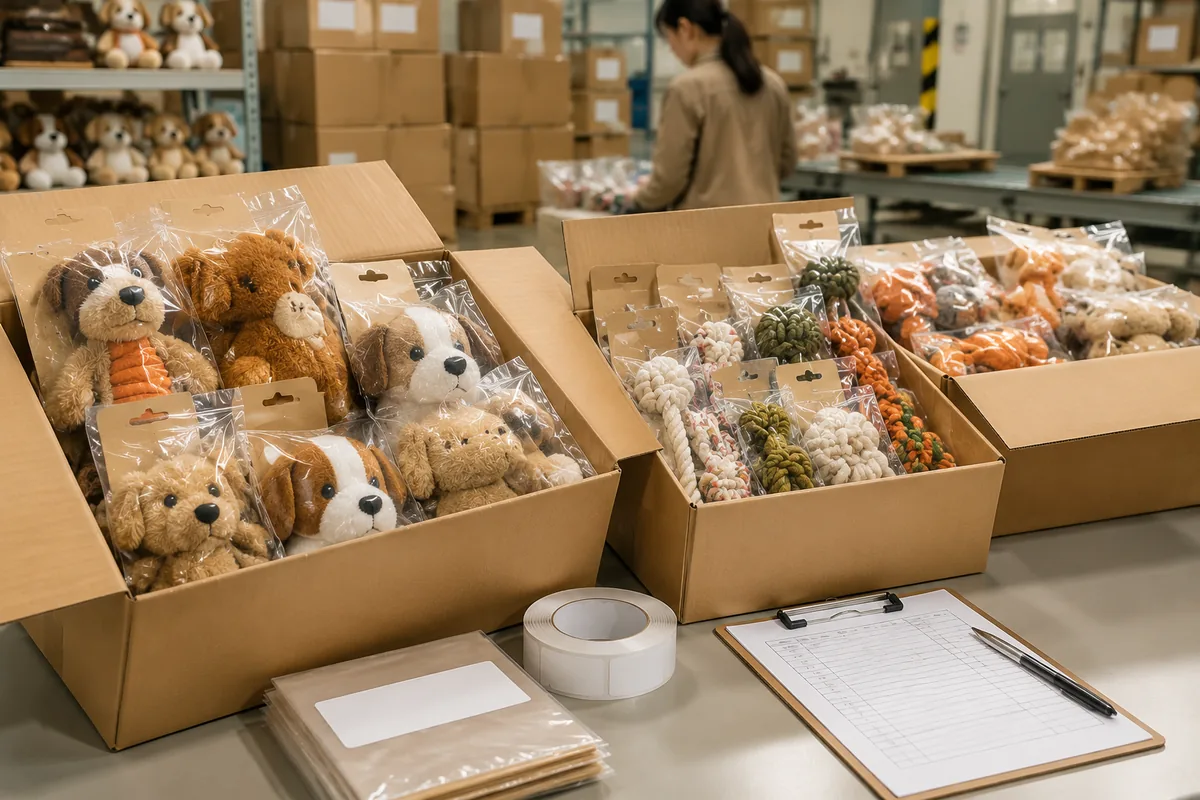
Unit price on the toy is only half the landed story. Print plates, dye lots on hangtags, and carton MOQ often drive the real first-order quantity more than sewing capacity.
Patterns many buyers see in recent RFQ conversations:
- Stock body + custom hangtag + woven label + plain polybag: often a few hundred units per SKU if the body already runs
- Custom printed polybag or header card on near-stock product: mid-hundreds upward depending on print run
- Full color retail carton + custom dieline + multi-language legal panel: higher MOQ; plate setup and minimum print runs can push into low thousands in some plants
- Mixed-SKU master cartons with assortment packing: packing labor and carton redesign can matter more than the toy unit cost
Always separate sample cost from bulk. A free “marketing mock” printed on the wrong stock will look perfect in photos and wrong in the warehouse. Ask for a pre-production pack using bulk materials: real bag film, real carton board, real barcode print quality.
Freight, testing, and packaging can erase a small unit-price win. Build a landed cost sheet before you celebrate a quote. For pure brand-on-product programs without full structure work, compare options on our private label page so you do not overbuy carton complexity you will not use.
Sampling timeline that does not wreck launch dates
Packaging has its own sample path. Treat it as parallel work, not a week-before-ship scramble.
1. Product sample first (or stock body confirmation) so dimensions are real
2. Artwork lock after product size and legal copy are frozen
3. Print proof (soft proof PDF, then hard proof if color is brand-critical)
4. Pre-production pack sample with bulk materials and real barcode
5. Bulk production only after you sign off pack-out photos and scan tests
Color shifts between screen and print are common. If terracotta and cream are brand-critical, ask for a hard proof on the actual substrate, not only a digital mockup. Hangtag card stock and polybag film take ink differently.
Lead time compounds: toy sewing + print house queue + carton dry time + packing labor. Put both calendars in the same project sheet. Missing that is how “product ready” becomes “waiting on boxes” for three weeks.
QC that catches packaging failures early
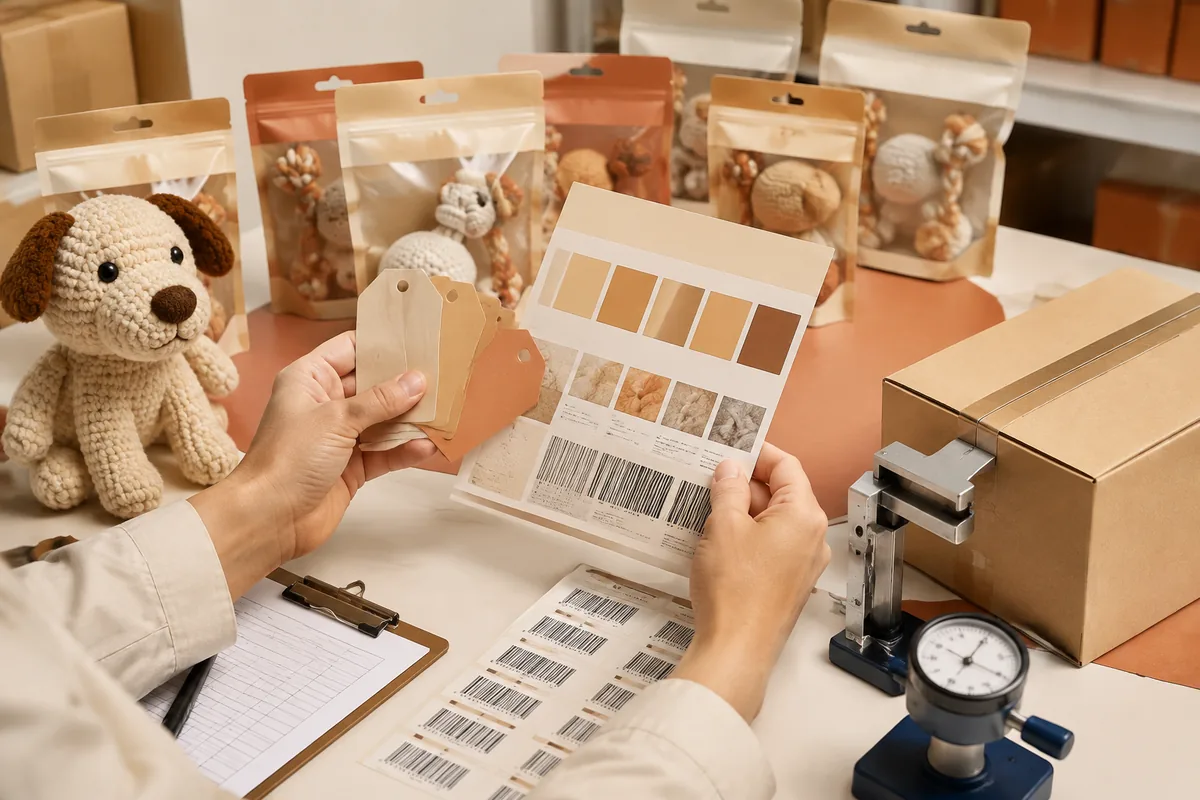
Product QC alone does not protect a private-label launch. Packaging fails in ugly, expensive ways:
- Wrong barcode or unreadable print after bag friction
- Color drift on hangtags vs brand guide
- Missing multi-language warnings for the destination market
- Carton crush that damages plush faces in transit
- Mixed SKUs in the wrong master carton ratio
- Hangtags that detach in the polybag and arrive as a pile of tags in the carton corner
Build packaging checks into the same AQL mindset you use for seams and fill. On first production runs, ask for photo or video evidence of:
- Scanned barcodes from a real scanner (not only human eyes)
- Side-by-side color check against approved proof under consistent light
- Carton drop or stack test for soft goods if you ship long haul
- Pack-out count per carton vs packing list
Document a simple issue log so the same defect does not reappear on reorder. For pet supplies private label with packaging design programs headed to US or EU retail, align lab test timing for the product with pack production so certificates are ready before cargo booking, not after the container is sealed.
Common mistakes brand buyers make
- Choosing unit price without freight, testing, packaging plates, and carton MOQ
- Freezing listing photos on a mock pack that never matches bulk materials
- Sending low-res logo files and then blaming the factory for fuzzy print
- Ignoring retailer inbound rules (label placement, case pack, ASN data)
- Treating warnings as optional marketing copy instead of legal text
- Approving soft proofs only, then discovering brand colors are off on kraft or film
- Running full custom dielines for a SKU that will change size after the first customer reviews
Skip these and you save a reorder cycle. Most packaging drama is brief quality, not factory malice.
How to RFQ a factory for product + packaging together
Send one packet that a plant and its print partner can share:
1. Product brief: materials, size, play style, compliance targets
2. Brand kit: logo vectors, pantones, placement map
3. Pack structure: primary and secondary pack types with rough dimensions
4. Data sheet: barcodes, languages, warning text, carton marks
5. Quantity plan: trial order, first reorder, mixed-SKU needs
6. Sample plan: product sample, print proof, pre-production pack
7. QC plan: AQL for product + packaging gates you will inspect
If the sales contact only talks product MOQ and waves packaging as “we can print anything,” push for the print MOQ and who owns the dieline. Vague answers usually mean a trading desk with a loose print partner.
When you are ready to compare programs, start from private label and ODM scope so you know whether you need hangtag-level branding or full structure design. For SKU direction before artwork, use the products page as a silhouette reference, not as a guarantee every plant can match fill density or embroidery map under your box window.
When stock packaging is enough (and when it is not)
Stock or near-stock pack is enough when:- You need speed and a clean brand label for marketplace photography
- SKU size may still change after first reviews
- Volume is still in trial hundreds, not confirmed thousands
- Retail buyers require shelf-ready structure and locked legal panels
- Brand unboxing is a marketing asset, not just a bag
- You have stable dimensions and a reorder forecast that absorbs plate cost
- Multiple markets need different language panels you can plan in advance
Jumping straight to custom dielines on an unproven SKU is a common cash burn. Lock the product, then dress it.
Pack-out quotes sharpen when product dimensions are real: hangtag-ready soft goods such as Kiwi and Lobster Seafood give dieline and barcode placement something concrete to measure against.
Next step for brand buyers
Pet supplies private label with packaging design works when product specs and pack specs travel in the same brief, the same calendar, and the same QC plan. Price alone does not tell you if barcodes will scan, cartons will survive a stack, or hangtags will match your brand guide on reorder.
If you want a practical review of product + pack-out for plush, rope, or hybrid soft goods, share your target market, SKU list, and whether you need hangtag-level branding or full retail structure. Use the contact page with dimensions, barcode status, and first-order quantity so a factory can quote product and packaging without guessing.
For broader catalog direction while you prepare artwork, keep the products list open next to your brand kit. That pairing — real silhouettes plus clear pack rules — is what turns a private-label idea into a shippable program.
Ready to Build Your Next Collection?
From material selection to final delivery, we help brands bring pet toys to market.