Pet Toy Certification for Importers: Docs, Labs, and PO Timing

If you source plush, rope, or rubber toys for retail or marketplaces, pet toy certification is less about a shiny logo on a hangtag and more about a paper trail that survives customs, platform audits, and a retailer’s vendor onboarding form. Buyers who treat certification as a last-minute checkbox often pay twice: once for rush lab fees, and again when a shipment sits while someone hunts for a missing Children’s Product Certificate or an outdated REACH report.
This guide is for brand owners, distributors, and Amazon / marketplace sellers who place real purchase orders with Chinese (and other Asian) factories. It covers what “certified” should mean in an RFQ, how product tests differ from factory system certificates, when to book labs relative to sampling, and how to keep documentation tied to the exact SKU you ship. For construction options before you lock a tech pack, browse the live products catalog. For a deeper walk-through of CPSIA, EN71, and REACH scopes, see our companion post on pet toy safety standards.
What buyers actually mean by pet toy certification

Search traffic for pet toy certification mixes two very different asks:
1. Product-level evidence — lab reports and certificates that match the construction you are importing (lead, phthalates, mechanical tests, flammability, chemical migration).
2. Factory-level systems — ISO 9001, social audits, or customer-specific vendor scorecards that say the plant can run repeatable QC, not that every SKU is automatically legal in every market.
Mixing those up is expensive. An ISO certificate on the wall does not replace a current test report for your squeaker compound. A beautiful ASTM F963 report from last year’s colorway does not cover this year’s Pantone change if the coating chemistry changed.
Write the RFQ in plain language: destination markets, channel (Amazon FBA, EU retail, indie shops), whether the item could be treated as a children’s product under CPSC logic, and which documents you need before cargo booking. Vague “full certification” requests invite vague answers.
Factory certificates vs product test reports
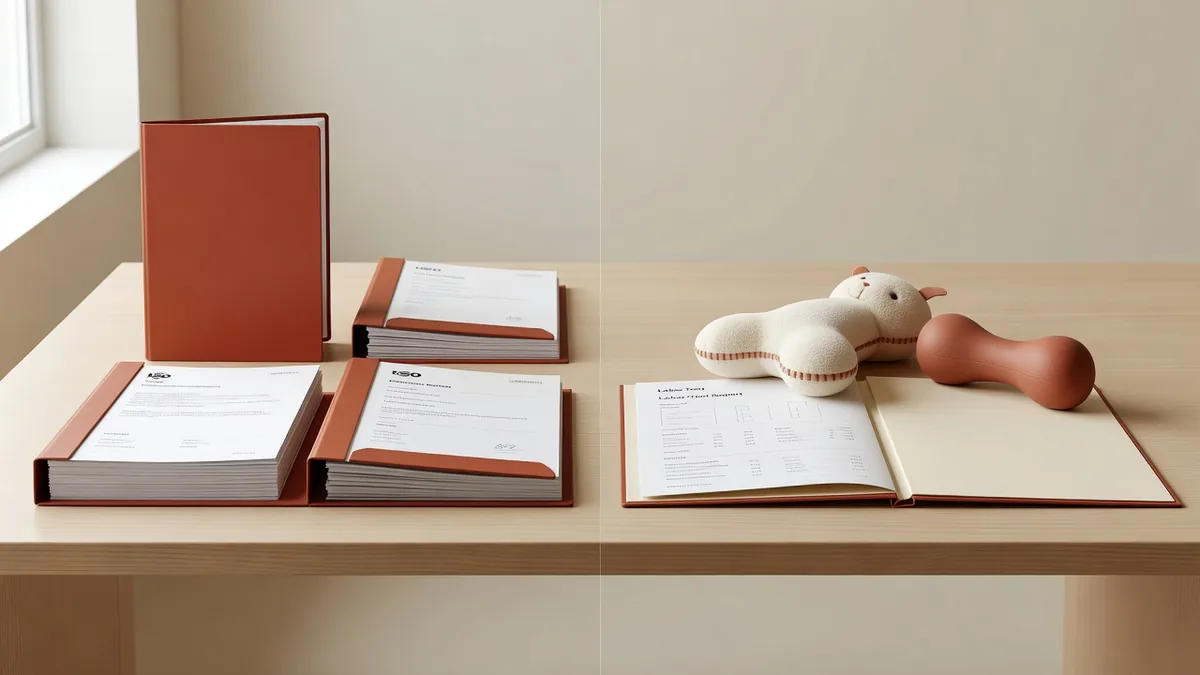
Factories love to say “we are certified.” Ask: certified for what, under which standard, for which SKU family, and dated when?
Factory / system documents (useful, not sufficient alone):- Quality management (often ISO 9001) and process control evidence
- Social / ethical audits required by certain retailers
- Capacity and equipment lists that show they actually run plush sewing, rope braiding, or rubber molding in-house
- Chemical and mechanical lab reports tied to material lots or finished goods
- Component part tests for shared parts (squeakers, eyes, coatings) reused across SKUs
- Tracking labels / lot coding plans when your market requires them
- Declarations that map bill-of-materials lines to the reports you hold
For US-bound goods that fall under children’s product rules, buyers typically need a Children’s Product Certificate (CPC) grounded in testing at a CPSC-accepted lab. For EU retail under the Toy Safety Directive path, EN71-based evidence and REACH-related chemical screens are the usual conversation. Do not invent pass/fail numbers in your brief—ask the factory which tests they already run on similar export lots and which you must book third-party.
If the plant cannot show how a report maps to your fabric GSM, your TPR compound, and your print ink, treat the PDF as marketing, not clearance.
Spec the compliance brief before tooling money moves
Certification work starts in the brief, not at the lab counter. Before you approve molds or bulk dye lots, lock:
- Target markets and channels (US only vs US + EU vs UK add-on)
- Construction family (plush with plastic eyes, cotton rope, TPR chew, hybrid)
- Materials you accept and materials you ban (example: no PVC if that is a brand rule)
- Preferred lab network or retailer-mandated labs
- Whether you need component testing (cheaper across a family) or finished-good testing only
- Who pays for failed tests and retests after a material swap
Hand that brief to the factory with your artwork and MOQ intent. Teams that skip this step often discover mid-PO that the “same” rubber ball uses a different plasticizer this season. For custom development where specs are still fluid, use an ODM path so the factory turns sketches into measurable constructions instead of guessing. When you need branded packaging and retail-ready cartons as part of the same program, plan a private label track so quotes include labeling and pack-out, not only bare FOB toys.
Sampling timeline that leaves room for the lab
A workable first engagement for pet toy certification looks like this in practice:
1. Brief + material recommendation (a few business days) — factory flags high-risk parts early (soft PVC, unknown coatings, glitter, battery modules).
2. Prototype / first sample — evaluate play feel and construction; do not burn the full lab budget on a shape you will change.
3. Revision sample — lock Pantone, fill weight, Shore hardness, seam method.
4. Pre-production (golden) sample — this is the one that should match bulk and, ideally, the sample sent to the lab.
5. Lab booking — schedule so reports land before cargo cut-off, not after the container is sealed.
6. Bulk with in-line and final inspection — photo evidence at each gate; keep an issue log for reorders.
Budget freight both ways on samples plus lab fees. Rush testing exists; it is priced like a problem, because it is one. Align lab timing with production so certificates are ready for booking, retailer portals, and marketplace document uploads.
Cheap samples that skip compliance often become expensive recalls or forced destructions later. If your channel requires annual retesting or lot-level evidence, put that cadence into the commercial terms so neither side is surprised on reorder.
QC gates that keep certificates honest
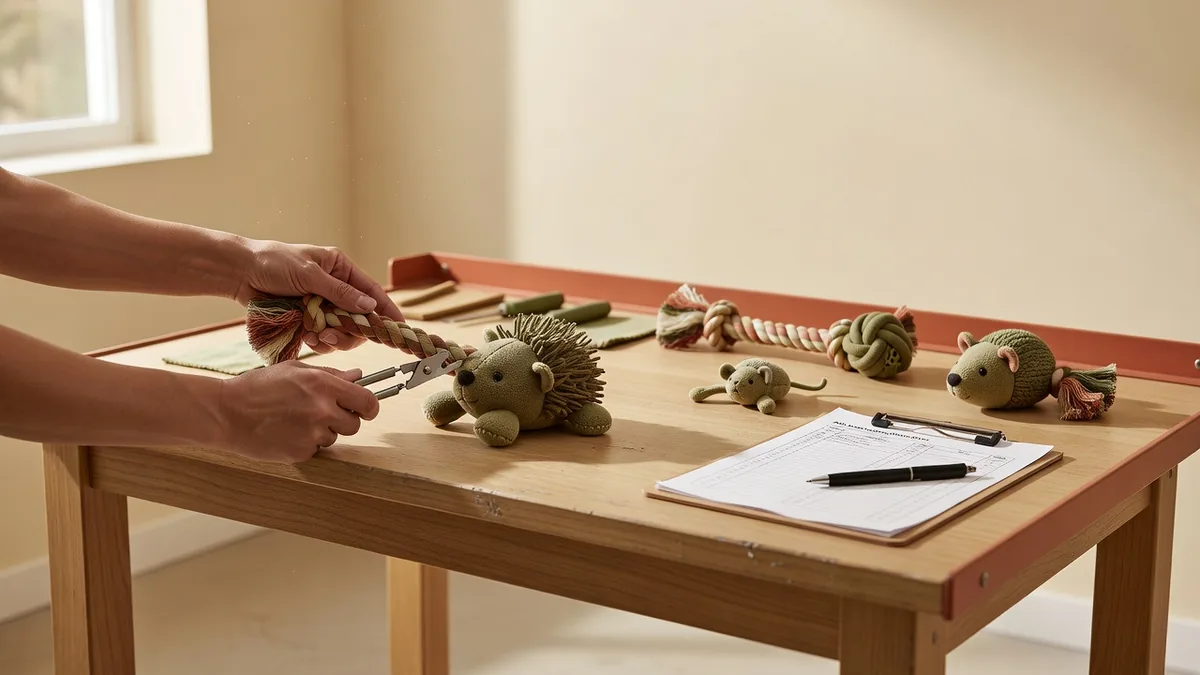
Certification paperwork fails in the real world when bulk drifts from the tested sample. Put QC into the PO:
Incoming materials- Fabric / rope dye lots against approved lab dips
- Rubber or TPR compound batch IDs that match what the lab saw
- Eye, nose, squeaker, and coating lots with declarations where your market needs them
- Seam strength on load zones, join strength on rope, flash cleanup on molded parts
- Stuffing weight tolerances and squeaker pocket integrity
- Color and logo placement against the signed golden sample
- AQL inspection against the approved sample
- Random pull for smell-after-seal checks on rubber / TPR
- Carton marks, barcodes, and warning copy that match the compliance file
Ask for photo or video evidence of each gate on first runs. Keep a shared defect log so the same seam failure does not reappear after you already paid for a clean report. Returns from failed attachments or torn TPR cost more than a slightly higher unit price with disciplined QC.
Packaging, labeling, and the documents that travel with the goods
Wholesale and brand buyers lose margin when packaging is an afterthought. Align early on:
- Inner polybag thickness and print (inks are chemistry too)
- Hangtags, care labels, tracking labels where required
- Master carton dimensions, drop expectations, and marks
- Multi-language warning copy for target markets
- How pack-out photos must match the shipped unit for marketplace PDPs
Your certification file should sit next to the packing list: which report covers which SKU, which component reports are reused, and who is the importer of record responsible for the CPC or equivalent paperwork. Inconsistent packaging is a top reason for customer returns on pet toys; mismatched documents are a top reason for portal holds.
Common mistakes that blow up pet toy certification programs
- Ordering bulk before the golden sample is signed and the lab sample is retained
- Reusing last year’s report after a material, coating, or supplier change
- Accepting “we are certified” without a document tied to the exact construction
- Changing fill, ink, or plasticizer mid-PO without updating cost and test scope
- Booking freight before reports are in hand “because the vessel won’t wait”
- Letting multiple stakeholders send conflicting revision emails with no single decision owner
- Ignoring packaging inks and adhesives as part of the chemical story
- Comparing open-stock FOB quotes to a private-label program that includes retail cartons and compliance support
Most post-shipment disputes on pet toys come from unwritten assumptions, not from bad intent. If it is still verbal-only, pause.
How WagNab runs certification-minded programs
WagNab manufactures pet toys for brand and wholesale partners — material selection, sampling, and bulk with QC discipline. Review live options on our products catalog, development process on ODM services, and brand packaging path via private label.
Teams evaluating pet toy certification usually start with a short brief: target pet and play style, material preferences, logo method, first-order quantity, destination markets, and which documents their retailer or channel already demands. From there we map a realistic sample plan and flag compliance needs before tooling money is spent. We do not invent MOQs, lab pass rates, or certificate claims in marketing copy — those belong in a scoped quote against your tech pack.
When you are ready to talk sampling windows and document checklists, contact WagNab with your SKU brief and markets. Share the channel requirements you already know (Amazon document list, EU retailer portal fields, preferred labs). That shortens the back-and-forth and keeps the first PO from becoming a paperwork fire drill.
Decision checklist before you place the PO
Use this before you commit:
- Spec sheet signed and versioned (materials, dimensions, tolerances)
- Golden sample approved in writing (photos + physical if needed)
- Lab scope agreed; sample retained; booking date that beats ship cut-off
- Factory system docs reviewed and product reports mapped to this BOM
- QC plan and AQL written into the PO
- Packaging dieline, warnings, and tracking labels approved
- Incoterms, payment terms, lead time, and retest rules on reorder written down
- One decision owner on the buyer side for revision emails
If any line is still “we’ll figure it out after deposit,” you do not have a certification plan yet — you have hope. Hope does not clear customs.
Next step. Send your target SKU brief, markets, and required document list. We will reply with sampling options, a practical lab timing sketch, and lead times that leave room for real paperwork — then you can contact WagNab to lock the trial order.Ready to Build Your Next Collection?
From material selection to final delivery, we help brands bring pet toys to market.