Toy Sustainability Testing: What Buyers Can Check Before Bulk

Start with a body you can actually order. Farm Animal Trio is a Studio Warmth plush. The catalog lists corn texture and polyester, size 33×22, about 71 g, MOQ 120, for dogs and cats. The line does not print a unit on that size, so confirm centimeters on the quote. It also does not list a recycled-content percentage, a fiber certificate, or a lab report. Treat that gap as the brief, not as a hidden promise. The wider products catalog shows the same pattern on most soft goods: construction is named, sustainability paperwork is not.
What the phrase usually hides
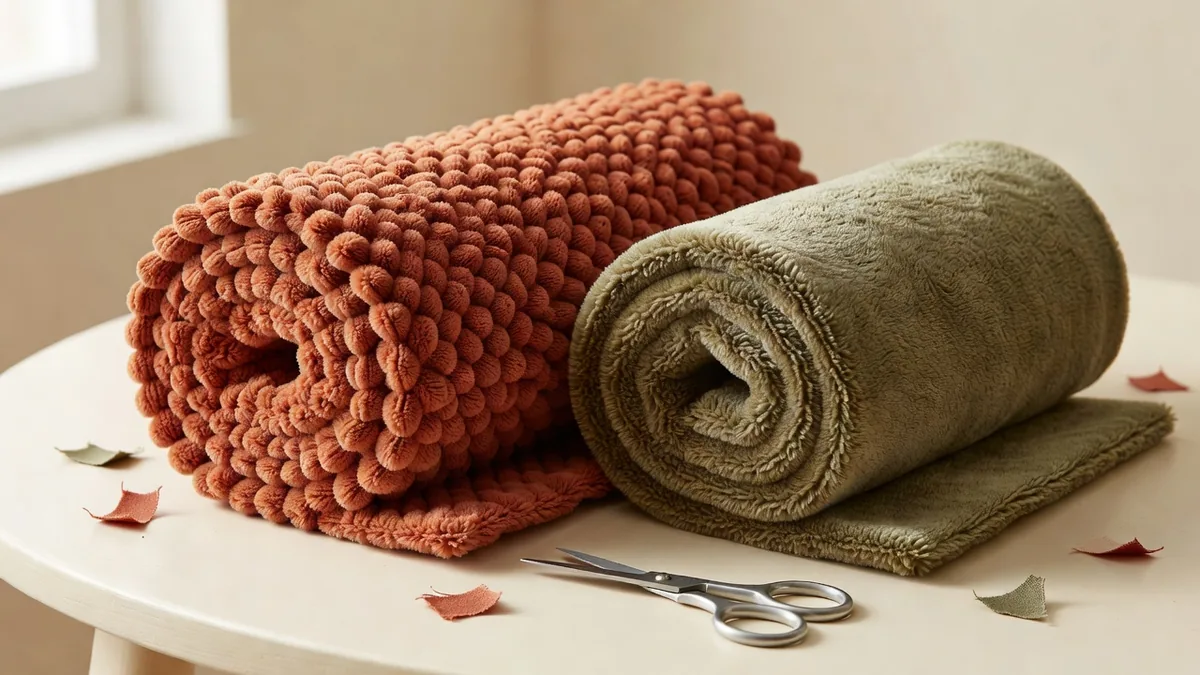
People type "toy sustainability testing" when they mean one of four different things. Mixing them up is how a carton gets a hangtag the retailer later rejects.
Hand-feel and construction. Does the outer fabric pill, does the seam open, does the fill clump after a wash the listing never promised? That is a sample-room job. You can do a lot of it with a golden sample, a pull by hand, and a written note. Chemical and physical screens for the destination market. If a retailer treats the SKU like a toy, they may ask for a named standard and a lab report on that exact bill of materials. A factory selfie of a clean workshop is not that report. Do not let a sales deck substitute for it. Claim substantiation. "Corn," "recycled," "eco," and "plant-based" are marketing words until composition by weight and a mill document sit in the file. Texture is not provenance. A nubbly face fabric can be conventional polyester with a corn-kernel knit. Our own catalog is explicit about this on several SKUs: the material field says corn texture and polyester, not "100% corn fiber." Ongoing reorder control. A passing report on sample A does not cover a quieter fabric mill on reorder B. Sustainability testing that only happens once, on a showroom piece, is a photograph.If your real question is seam strength and squeaker life, read a durability plan instead of forcing it into a green headline. If your real question is whether the hangtag can say recycled polyester, you are in claim territory, and the catalog as it stands today will not carry that sentence for you.
Materials you can name before you test anything
You cannot brief a lab on a mood board. You brief it on parts.
On the corn-texture group, the database is narrow and useful:
| SKU | Listed materials | Size on file | Weight | MOQ |
| --- | --- | --- | --- | --- |
| Farm Animal Trio (MN-1095) | Corn texture, polyester | 33×22 | 71 g | 120 |
| Naughty Pig (MN-1098) | Corn texture, polyester | 18×23 | 85 g | 120 |
| Corn Kernel Fawn (MN-1086) | Corn texture, polyester | 28×15 | 65 g | 240 |
| Crinkly Socks (MN-1105) | Corn texture, polyester | 16×7 | 25 g | 360 |
Naughty Pig is the compact one: 18×23, about 85 g, same material pair, MOQ 120. Crinkly Socks drops to about 25 g at 16×7, with MOQ 360. Lighter piece weight changes how many units you need to ship for a lab that asks for a minimum sample mass. It does not make the socks "more sustainable." It just changes the carton math. Corn Kernel Fawn sits in between at 28×15, about 65 g, MOQ 240. Same material wording. If a buyer wants four corn-texture bodies in one program, the MOQ is not one number. It is 120, 120, 240, and 360 on these four lines. Quote them separately or you will approve a sample set you cannot actually replenish at the same threshold.A few things these rows do not say, and should not be inferred:
- No Shore hardness, because these are not molded chews.
- No fill ratio. Ask the factory what is inside: virgin polyester, a recycled fill, or a blend. If they cannot name it, the test plan has nothing to attach to.
- No certification field is filled on these SKUs. Empty is not "pending EN71" and it is not "OEKO-TEX." Empty means confirm on the quote.
- "Corn texture" describes the face. It is not a license to print "made from corn" on a header card.
For a smoother contrast, crystal plush bodies such as Bear (crystal plush and polyester, 15×25 cm, about 72 g, MOQ 120) show how the same sewing plant can run two hand-feels. Sustainability testing still starts with the BOM, not with which one looks softer in a photo.
Sample bench versus lab
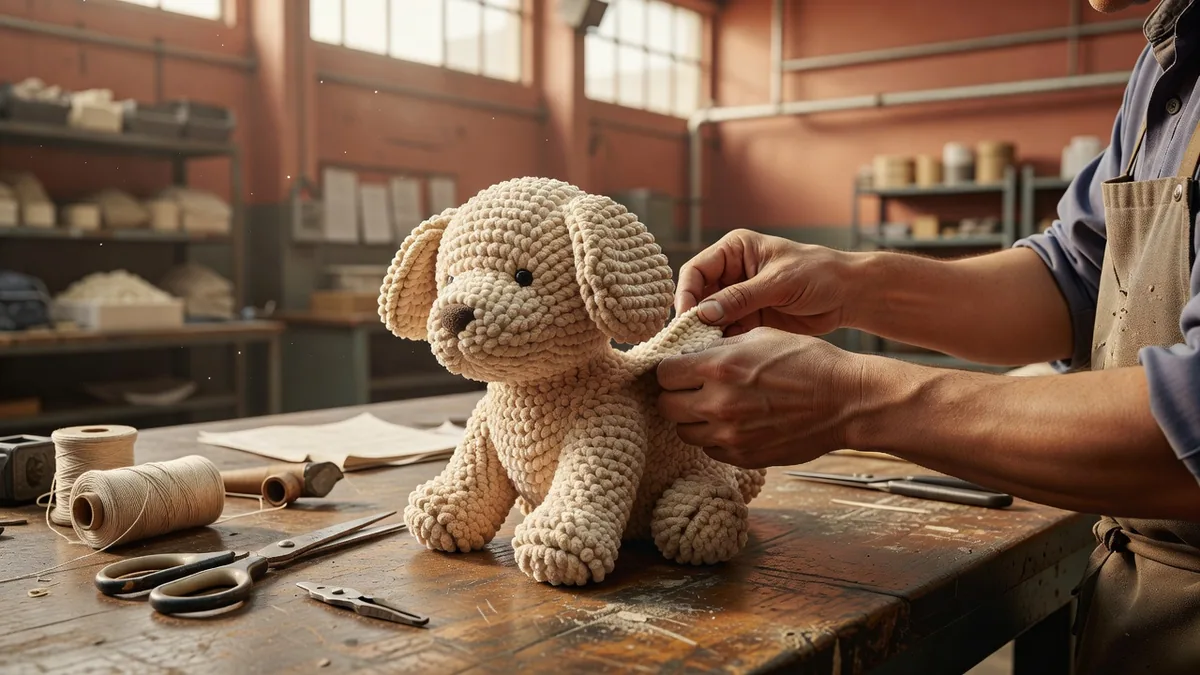
Keep the cheap checks at your desk or at the factory table. Send the expensive ones out only after the BOM is frozen.
On the bench, before anyone talks about a green claim:
1. Weigh the sample against the catalog weight. Farm Animal Trio at 71 g should not arrive at 40 g "because the fill was optimized." That is a different product.
2. Photograph the face fabric next to the approved swatch. Corn texture pills and shines differently from crystal plush. A last-minute substitute fabric is the most common silent change on soft lines.
3. Pull ears, legs, and any knot or strap by hand. Write the failure in plain language ("left ear seam opened") instead of a score you invented.
4. Open one unit if the construction allows it, and note fill type, eye or nose hardware, and whether a squeaker is present. Each of those is a separate material for a lab, even when the toy looks like one object.
5. Wash or wipe only the way the care label will allow. If you have not written a care label yet, do not test a method you will later forbid.
What does not belong on that list: a pass/fail against a named chemical regulation, a recycled-content percentage, or a sentence like "safe for all dogs." Those need a lab, a named method, and the same parts you will ship. Budget the lab on the golden sample after color and fabric are locked, not on the first rough sew. A color change can change dye chemistry. A hardware change can change the metal or plastic the lab never saw.
Ask the plant who owns incoming fabric records. If the answer is "our trading office handles compliance," you still need the mill name or a lot code in the file. Otherwise the next container can pass a visual QC and fail the claim you already printed.
Turnaround is the part buyers under-budget. Physical abuse on a sample can finish in a day. A third-party chemical screen often needs the booking, the courier, and a queue. Build that into the date you promise a retailer, not into the week you also hoped to cut cartons.
How to brief the test so the quote stays honest
A usable RFQ for toy sustainability testing is boring. That is a compliment. It lists parts, markets, and the exact words you hope to print. It does not ask the factory to "make it eco."
Write the brief in this order:
Parts. Outer fabric composition by weight, fill composition, thread, embroidery, eyes or noses, squeaker housing if any, and packaging (polybag, header card, ink). Corn texture plus polyester is a starting label, not a finished BOM. Market. Name the country and the channel. A marketplace listing and a European retailer do not ask for the same paper. If you do not know which standard your buyer requires, say so, and do not let the factory guess a logo. Claim you want, and claim you will not make. Example: "We may say corn-texture polyester plush. We will not say biodegradable, plastic-free, or recycled until a document supports that word." That single line prevents a well-meaning salesperson from adding a leaf icon to the dieline. Sample identity. Date, size, weight, and a photo of the unit that will be tested. If you test Naughty Pig and then produce Crinkly Socks under the same report number, you do not have coverage. Different mass, different MOQ, different SKU. Who pays and who owns the PDF. Labs bill someone. If the report is in the factory's name and you cannot share it with your retailer, you paid for a document you cannot use. Put sharing rights in the PO.Private-label programs add artwork risk on top of material risk. A new header card is a new ink and a new board. Route that through private label when the claim lives on the card, not only in a product description. If the body itself is a new pattern, a new fill, or a changed trim, the sampling path on ODM is the right place to freeze the BOM before the lab booking. Open-stock corn-texture bodies are the cheaper way to learn the test cycle, because you are not also paying for a pattern you might abandon.
Colorways are where claims go to die quietly. Approving "the same toy in four colors" is fine for a lookbook. It is not fine for one lab PDF if the dye package changes. Either test the colors you will sell or state, in writing, that the report covers only the color submitted.
MOQ, pack-out, and reorder
Sustainability paperwork does not lower an MOQ. On these corn-texture references the floor is 120 on Farm Animal Trio and Naughty Pig, 240 on Corn Kernel Fawn, and 360 on Crinkly Socks. A lab fee on top of a 120-unit trial is often the real reason a "green" SKU dies, not the fabric price. Price the test before you promise a retail buyer a date.
Pack-out is part of the test scope if you ship in a printed bag. A plain polybag with a sticker you can swap is easier to correct than a full-bleed bag that already says "eco corn." Keep the first production bag quiet until the report matches the goods in the carton. The photo standard should be the quiet one: product, size, material words you can defend today.
On reorder, repeat the bench checks even when you skip a full lab rerun. Weigh five units. Compare face fabric to the swatch. Confirm the fill description on the packing list still matches the approved BOM. If the factory changes mill "for the same hand-feel," stop and decide whether the old report still applies. Most of the time it does not.
Retailers also ask what you will do when a lot fails incoming inspection on their side. Agree that before the PO: rework, replace, or credit. A sustainability claim does not change that commercial clause. It only adds one more way to fail.
What to do this week
Pick one live body, not a sketch. Farm Animal Trio is the simplest hero if you want a larger corn-texture piece at MOQ 120. Naughty Pig is the alternative if you want a similar material story in a smaller outline, also at MOQ 120. Crinkly Socks only makes sense if 360 units and a very light 25 g piece fit the channel.
Then write a one-page brief: BOM blanks, the claim you refuse to print yet, the market, and who owns the lab PDF. Send that with the sample request. If the reply is a paragraph about being a green factory and no composition line, you do not have a test plan.
When the brief is ready, send it through contact with the SKU codes (MN-1095, MN-1098, MN-1086, MN-1105) and the market you actually sell into. We can confirm which of those corn-texture bodies are open for the quantity you need, and which words have to wait for paperwork you do not have yet.
Ready to Build Your Next Collection?
From material selection to final delivery, we help brands bring pet toys to market.