Wholesale Plush Dog Toys China Factory: Buyer Vetting Checklist

If you are looking for a wholesale plush dog toys China factory, you already know the catalog middle is noisy. Soft toys photograph well. The gap between a pretty listing and a cart that survives retail QC is where most first-time importers lose time and money.
This piece is for brand owners, Amazon and marketplace sellers, and wholesale distributors who need plush that ships on schedule, passes basic safety screens, and does not explode into returns after two weeks of real dog play. Not theory. The checks that actually separate a sewing line from a partner you reorder with.
What "wholesale plush factory" usually means in China
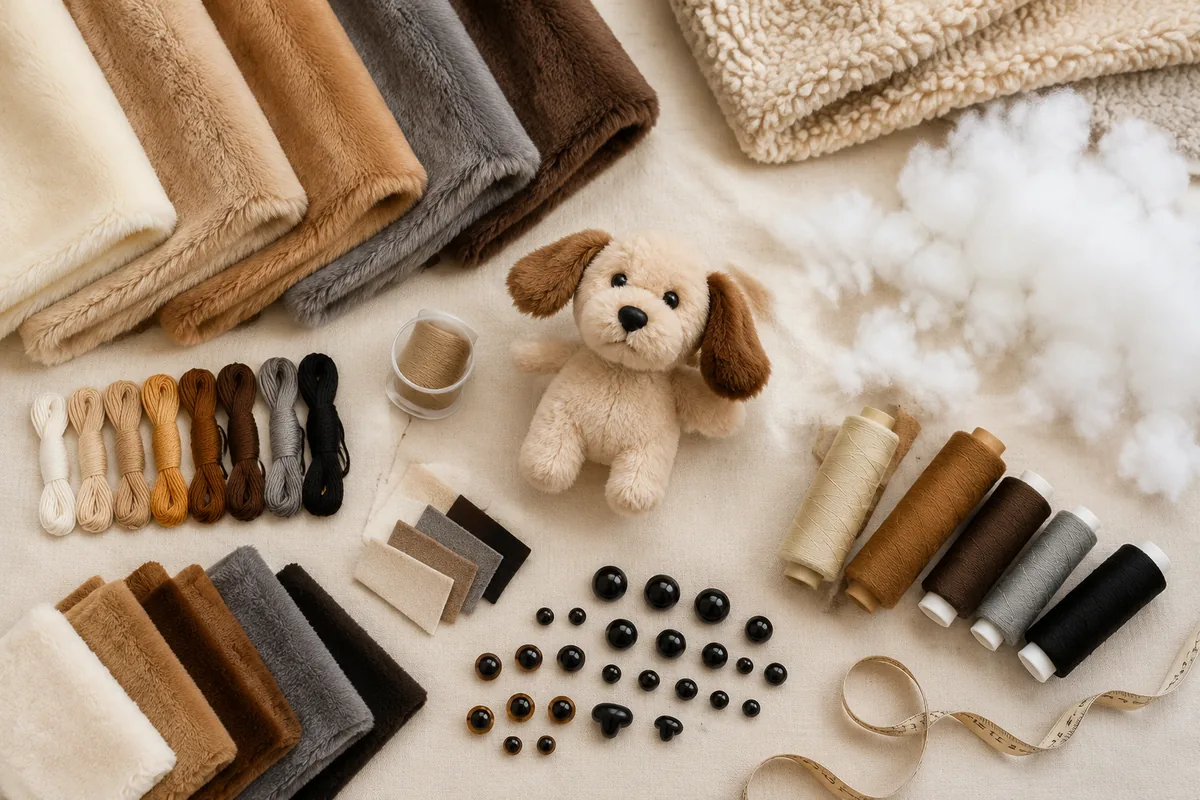
On export platforms, almost anyone with a sewing floor can call themselves a factory. In practice you will meet three different businesses under the same keyword.
Trading companies with a sewing partner. Fast quotes, flexible English, thin control of stitch quality once the PO is placed. Fine for simple catalog fills if you inspect hard. Weak for a branded character that needs consistent embroidery across reorders. Mixed apparel / kids-plush plants that also run pet SKUs. Capacity is real. Pet durability is not always the default. Ears, limbs, and squeaker pockets get the same construction as nursery toys unless you write stress points into the tech pack. Pet-focused soft-goods lines. Smaller product range, more honest about MOQ on custom colors, and usually better at double-stitching load zones. These are the houses most mid-size brands end up preferring after one bad return spike.Ask early what share of output is pet vs human plush. If the answer is vague, assume you are the training program.
For SKU direction before you lock a body shape, browse our products catalog. Plush, silicone, and rope behave like different supply chains even when they sit in the same pet aisle.
Who actually buys wholesale plush (and what they need)
Most serious traffic on this keyword falls into a few buckets:
- DTC brands that want a soft companion SKU next to hard chew and rope
- Marketplace sellers refreshing private-label characters without new hard tooling
- Retail buyers building a value or seasonal soft-toy set
- Distributors filling a wholesale assortment for independent pet shops
If your main product is solid TPR for power chewers, you are not in a plush factory decision. Plush is fabric, fill, embroidery, finishing, and labeling. Treat it like soft goods plus toy safety, not like rubber molding.
Wholesale buyers also care about carton efficiency and mixed SKU packing more than brand buyers do. Say that up front. A factory that only thinks in monochrome 1,000-piece cartons will frustrate assortment programs.
Spec checklist before you send an RFQ
Vague briefs create samples you cannot sell. Send something a production manager can quote without inventing your product.
Play and size- Dog size band (toy / small / medium / large) and play style: gentle companion, moderate tug, or "decorative until destroyed"
- Finished size in cm (body length, not including floppy legs if you measure differently)
- Character type: animal, food shape, geometric, mascot (confirm IP is cleared)
- Outer fabric: short plush, long pile, sherpa, corduroy, canvas panels on high-wear zones
- Pile height or GSM if hand-feel consistency matters across reorders
- Fill: polyester fiberfill density range; recycled-content claims need documentation, not a sentence on a hangtag
- Inserts: squeaker count and type, crinkle, rope limbs
- Seam type and stitch density at ears, limbs, and neck
- Eyes and nose: embroidery only vs plastic with locking washers (plastic parts need stricter small-parts discipline)
- Reinforced openings if you want washability without fill migration
- Woven label, printed hangtag, heat-transfer or embroidery logo placement
- Polybag print, carton marks, barcode, multi-language warnings for US / EU
- Destination markets and test expectations (commonly CPSIA-oriented chemical thinking for the US; REACH / EN71-related screens when EU retail treats the item like a toy)
A clean brief shortens sample rounds. Factories quote faster when they are not guessing.
MOQ and cost reality for wholesale plush
Wholesale unit price is only half the story. Fabric dyeing, embroidery digitizing, and line changeover drive MOQ more than how polished the sales deck looks.
Patterns many buyers see in 2025–2026 conversations:
- Stock or near-stock bodies with colorway + label + hangtag: often a few hundred units per SKU if the body already runs
- New fabric color on an existing shape: mid-hundreds upward depending on dye lot size
- Fully custom shape + new embroidery map: higher MOQ and longer sampling; expect low thousands in some plants if the shape is complex
Always separate sample cost from bulk. Cheap free samples that skip your real fabric often become expensive when bulk feels different. Ask for the bulk fabric lot on the pre-production sample, not only the showroom swatch.
Freight, testing, and packaging can erase a 5–8% unit-price win. Build a landed cost sheet before you celebrate a quote.
Sampling timeline that does not wreck launch dates
A realistic first engagement for a wholesale plush dog toys China factory often looks like this:
1. Brief review and material recommendation (2–5 business days)
2. Prototype or first sample (often 10–20 days depending on embroidery and fabric stock)
3. Buyer feedback and one revision round
4. Pre-production sample locked against the PO (same materials as bulk)
5. Bulk with in-line checks and final inspection before booking cargo
Budget freight both ways on samples plus lab tests if your channel requires certificates before intake. Signing off a pretty photo sample and then changing fabric mid-PO is how ship windows slip.
If you need full custom development rather than wholesale on existing bodies, map the longer path on our ODM services page before you commit calendar dates to retail.
Quality control that catches plush failures early
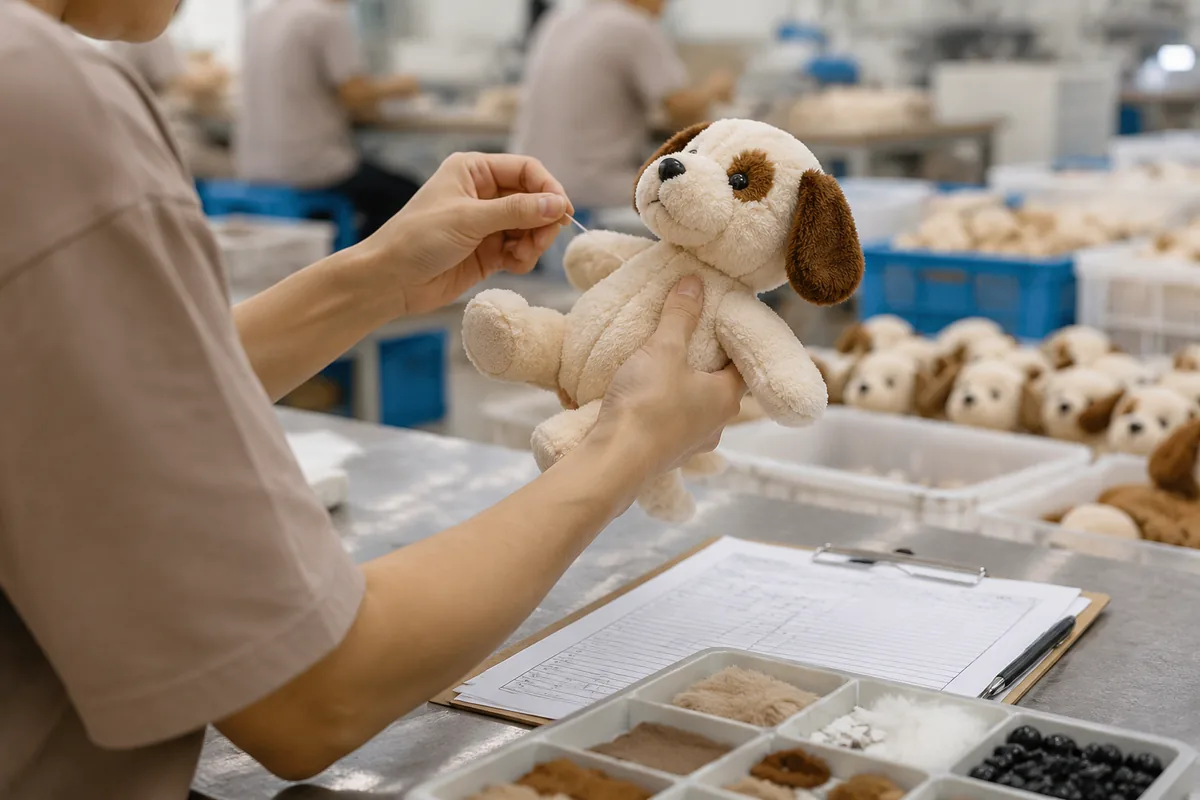
Plush fails in predictable ways: open seams at limbs, fill clumping after wash claims, loose plastic eyes, squeakers that rattle free, embroidery that frays after a few tugs.
Insist on multi-stage QC even on trial orders:
- Incoming fabric and fill checks (color, weight, odor)
- In-line seam and attachment checks during sewing
- Finished-goods inspection against a written AQL
- Pre-shipment carton count and pack-out photos
Document a simple AQL plan early. It trains the factory before volume grows. On first runs, ask for photo or video evidence of each gate. Keep a shared defect log so the same ear seam does not reappear on reorder.
For programs headed to US or EU retail, align lab test timing with production so certificates exist before the container is sealed, not after.
Packaging, labeling, and retail readiness
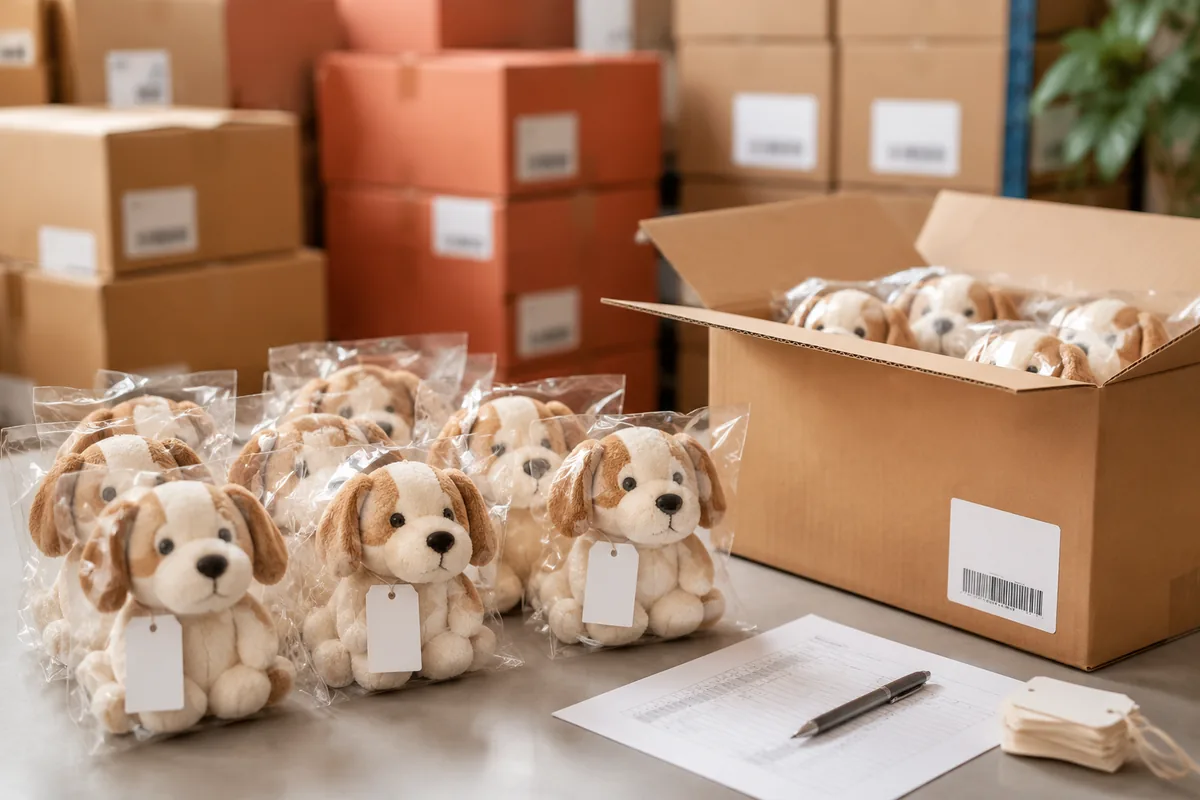
Wholesale margin dies when packaging is an afterthought. Align early on:
- Inner polybag thickness and print
- Hangtags, care labels, barcode placement
- Master carton dimensions and drop expectations
- Multi-language warning copy for target markets
Marketplace sellers should confirm pack-out photos match the shipped unit. Inconsistent packaging is a top reason for customer confusion and returns on soft toys.
If you are building a brand line rather than pure wholesale assortment, private label packaging and logo methods should be locked at the same time as the body design, not two weeks before ship.
Common mistakes brand and wholesale buyers make
- Choosing on unit price without freight, testing, and packaging
- Skipping a real durability check (even a rough tug and wash test beats none)
- Vague artwork files that delay embroidery and logo placement
- Ignoring labeling rules for the destination market
- Changing materials mid-sample without updating the cost sheet
- Assuming the factory "just knows" your retailer's intake checklist
- Ordering bulk before the pre-production sample is signed in writing
- Running too many revision owners on the buyer side (conflicting comments kill schedules)
Communication cadence that protects ship windows
Factory silence is a risk signal. Once the PO is live, agree on a weekly update: materials in, sewing progress, QC photos, and ship window. For Q4 gifting and other seasonal peaks, lock capacity earlier than feels comfortable. Pet retail calendars compress sewing bandwidth.
Share one decision owner on the buyer side. Multiple stakeholders sending conflicting embroidery notes is the fastest way to miss a sail date.
When wholesale stock is enough vs when you need custom
Stay closer to wholesale / catalog-adjacent private label when:- You need speed and a known body shape
- First order is a market test under a few hundred units per color
- Differentiation is mostly color, label, and hangtag
- The character is your brand asset and must not look like a shared factory body
- You need a unique size or construction for a specific dog segment
- Retail exclusivity or a license-ready look matters
Many programs start wholesale-adjacent, then migrate pieces of the line into custom once sell-through is proven. That is a sane path. Trying to fully custom every SKU on day one is how cash and calendar both get burned.
Decision checklist before you place the PO
- Spec sheet signed and versioned
- Sample approved in writing (photos plus physical if needed)
- QC plan and AQL agreed
- Packaging dieline approved
- Incoterms, payment terms, and lead time written into the PO
- Contingency for one revision cycle without killing the launch window
- Lab test plan timed to cargo booking if your market needs certificates
If any of those is still verbal-only, pause. Most post-shipment disputes on pet plush come from unwritten assumptions, not from bad intent.
How WagNab works with wholesale and brand buyers
WagNab builds pet toys for brand and wholesale partners—from material selection through sampling and bulk. Start with live directions on our products catalog, deeper development on ODM, or brand packaging routes via private label.
Teams evaluating a wholesale plush dog toys China factory usually start with a short brief: target dog size, fabric preference, logo method, first-order quantity, and destination market. From there we map a sample plan and flag compliance needs before money goes into embroidery maps or new bodies.
Ready to talk MOQ and sampling windows? Contact WagNab with your SKU brief and target markets. We will respond with realistic lead times—not a generic catalog PDF.
Wholesale plush quotes sharpen when buyers name bodies: try Drumstick for food-shape velocity and Donut for compact gifting SKUs.
Related reading
Need lower first-order risk? Read low MOQ pet toy manufacturer China plush and rope. Custom embroidery paths are in custom plush dog toys manufacturer China.
Ready to Build Your Next Collection?
From material selection to final delivery, we help brands bring pet toys to market.